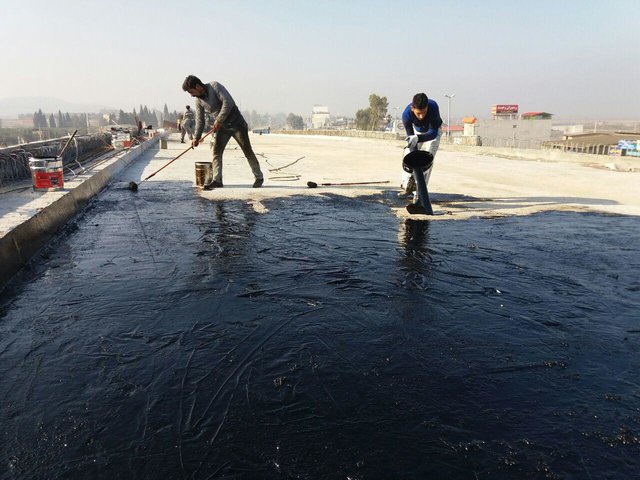
Differences Between BOF and BPP

Differences Between BOF and BPP Bituminous Waterproofing Membrane
In terms of the type of bitumen used in isogam production, there are two main types: molten or BOF isogam. This type of bituminous waterproofing membrane uses mazut or molten bitumen in the manufacturing process.
To produce molten bitumen, hot air (between 200 to 300 degrees Celsius) is introduced to the heated bitumen in the final purification stage. This hot air is delivered through perforated pipes to a chamber containing the bitumen, causing the hydrogen atoms in the bitumen molecules to combine with the oxygen in the air. This process results in the formation of water molecules and triggers the polymerization process.
BPP or Polymer bituminous waterproofing membrane
Polymer bituminous waterproofing membrane is produced from pure bitumen known as pure bitumen 60-70. In this type of bituminous waterproofing membrane, more polymer materials are used compared to other bituminous waterproofing membrane, hence its designation as a polymer bituminous waterproofing membrane.
Pure bitumen is obtained from crude oil refining in refineries. After separating gasoline, petroleum solvents, diesel, and other components from the refined oil, pure bitumen remains. This pure bitumen, obtained at normal air pressure and at a temperature of about 380 degrees Celsius, is solid or semi-solid.
Advantages of BOF bituminous waterproofing membrane
- Lower cost: The primary benefit of molten isogams is their lower cost. This type of isogam, as it does not use pure bitumen, is more cost-effective.
- Greater flexibility: This product has greater flexibility compared to other types.
- Lower temperature sensitivity: BOF bitumens have less sensitivity to temperature changes.
Disadvantages of BOF bituminous waterproofing membrane
- Lower quality: Molten isogam has lower quality and a shorter lifespan compared to BPP isogam.
- Unpleasant odor: Molten isogam has an odor similar to diesel, which may not be desirable for some.
Advantages of BPP bituminous waterproofing membrane
- High Quality and Long Lifespan: Polymer isogam, owing to its high quality, has an average lifespan of over 15 years.
- Temperature Tolerance: This type of isogam is highly flexible in the face of temperature variations, tolerating temperatures from -5 degrees Celsius to 100 degrees Celsius.
- Low Weight: As polymer isogam is made from pure bitumen, it has lower thickness and weight, preventing undue pressure on the structures where it is used.
- Higher Adhesiveness: The molecular distance in polymer isogam is much smaller, resulting in higher adhesiveness.
- Better Odor: If the odor of isogam is a concern, BPP isogam has a better smell compared to molten models.
Disadvantages of BPP bituminous waterproofing membrane
Higher Cost: The price of this type of isogam is higher compared to its molten counterpart.